

|
|
|
|
|
|
|
|
|
|
|
|
| genus c | 4, orientable |
| Schläfli formula c | {6,6} |
| V / F / E c | 6 / 6 / 18 |
| notes | 


|
| vertex, face multiplicity c | 2, 3 |
| 6, each with 6 edges 6, each with 6 edges 6, each with 6 edges 18, each with 2 edges 18, each with 2 edges | |
| antipodal sets | 3 of ( 2f ), 3 of ( 2e, 2h3 ) |
| rotational symmetry group | 36 elements. |
| full symmetry group | 72 elements. |
| its presentation c | < r, s, t | t2, (rs)2, (rt)2, (st)2, r6, s‑1r3s‑1r, s6 > |
| C&D number c | R4.8 |
| The statistics marked c are from the published work of Professor Marston Conder. | |
Its dual is
It is self-Petrie dual.
It can be derived by stellation (with path <1,-1;-1,1>) from
List of regular maps in orientable genus 4.
Its skeleton is 2 . K3,3.
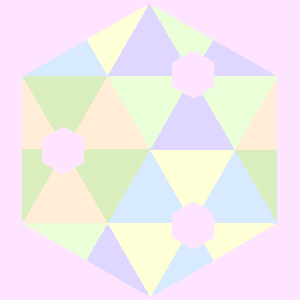
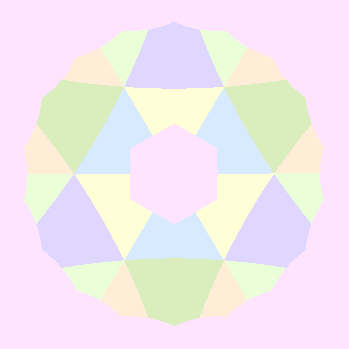
The second diagram above, with one hexagonal "hole" in its centre, was derived from the diagram of its dual on page 46 of H01, where it is considered as a dessin d'enfant. That graph is bipartite, and the actions of the dessin act on the edges of the graph to generate S3×C3. The authors obtained it by a method they term "origami".
| Orientable | |
| Non-orientable |
The images on this page are copyright © 2010 N. Wedd